Campus Network Lab
A Cisco Packet Tracer lab of a fictional university network. The design, device configs, and automated checks are done; the Packet Tracer build and hands-on testing are in progress.
- Cisco Packet Tracer
- VLANs
- 802.1Q trunking
- Inter-VLAN routing
- DHCP
- ACLs
- SSH
- Python (pytest)
- JavaScript
In development. This page describes the goals and what is finished so far. Results, screenshots, and links are added only after they have been checked.
Overview
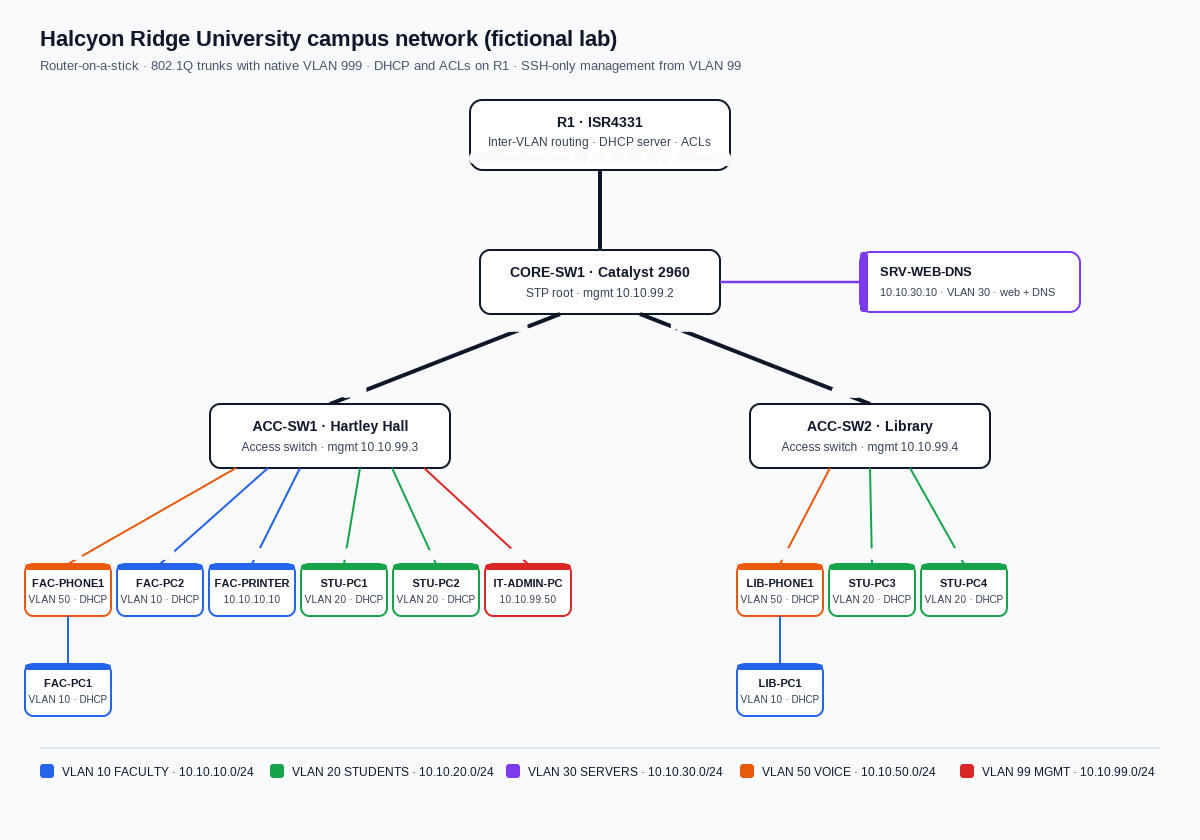
A campus network for a fictional school, Halcyon Ridge University, designed for Cisco Packet Tracer: five VLANs trunked over 802.1Q, inter-VLAN routing on a router-on-a-stick, DHCP with exclusions, a voice VLAN for IP phones, ACLs that control who can reach what, and SSH-only device management.
Policy explorer
Loading the policy explorer. It runs in your browser and needs JavaScript.
Problem
A campus network has to keep groups like faculty, students, servers, and phones on separate networks while still letting each one reach the services it needs, and only IT should be able to manage the network devices.
Solution
Each group gets its own VLAN and subnet. One router routes between them and hands out addresses with DHCP. Two extended ACLs decide which traffic is allowed, and the switches and router only accept SSH from the management VLAN.
Goals
- Will build the network in Packet Tracer by following the lab's build guide and pasting in the finished configs.
- Will run the 32 end-to-end allowed/blocked traffic tests from the verification checklist and record the results.
- Will add real Packet Tracer screenshots and the saved .pkt file once the build is verified.
Architecture
- R1 (ISR4331): router-on-a-stick with one subinterface per VLAN, the DHCP server, and the ACLs.
- CORE-SW1 plus two access switches (Cisco 2960s), connected by 802.1Q trunks with a dedicated native VLAN.
- VLANs 10 Faculty, 20 Students, 30 Servers, 50 Voice, and 99 Management, on 10.10.x.0/24 subnets.
- Students are blocked from internal networks except the campus web and DNS server, and the server VLAN only allows the services it offers.
Testing
- Automated design checks (pytest) read the config files and verify the addressing plan, VLANs and trunks, DHCP pools, SSH settings, and 32 allowed/blocked ACL traffic cases. They run on GitHub Actions and are currently passing.
- The policy explorer on this page is a JavaScript port of the Python ACL checker that runs on the real config files in the browser. For all 32 cases it gives the same result and the same reasoning as the Python version, and its own tests check that every line of R1's two ACLs decides at least one case.
- Not yet tested in Packet Tracer: pasting the configs into Packet Tracer and checking end-to-end connectivity is the next step.
Screenshots & diagrams
(opens full size in a new tab)Limitations
- Not yet built or tested in Packet Tracer, so there is no .pkt file and no Packet Tracer screenshot.
- The automated checks read the config files; they don't prove the configs behave the same on Packet Tracer's simulated devices.
Who did what
- Portfolio project designed by Nathanael Haig.